
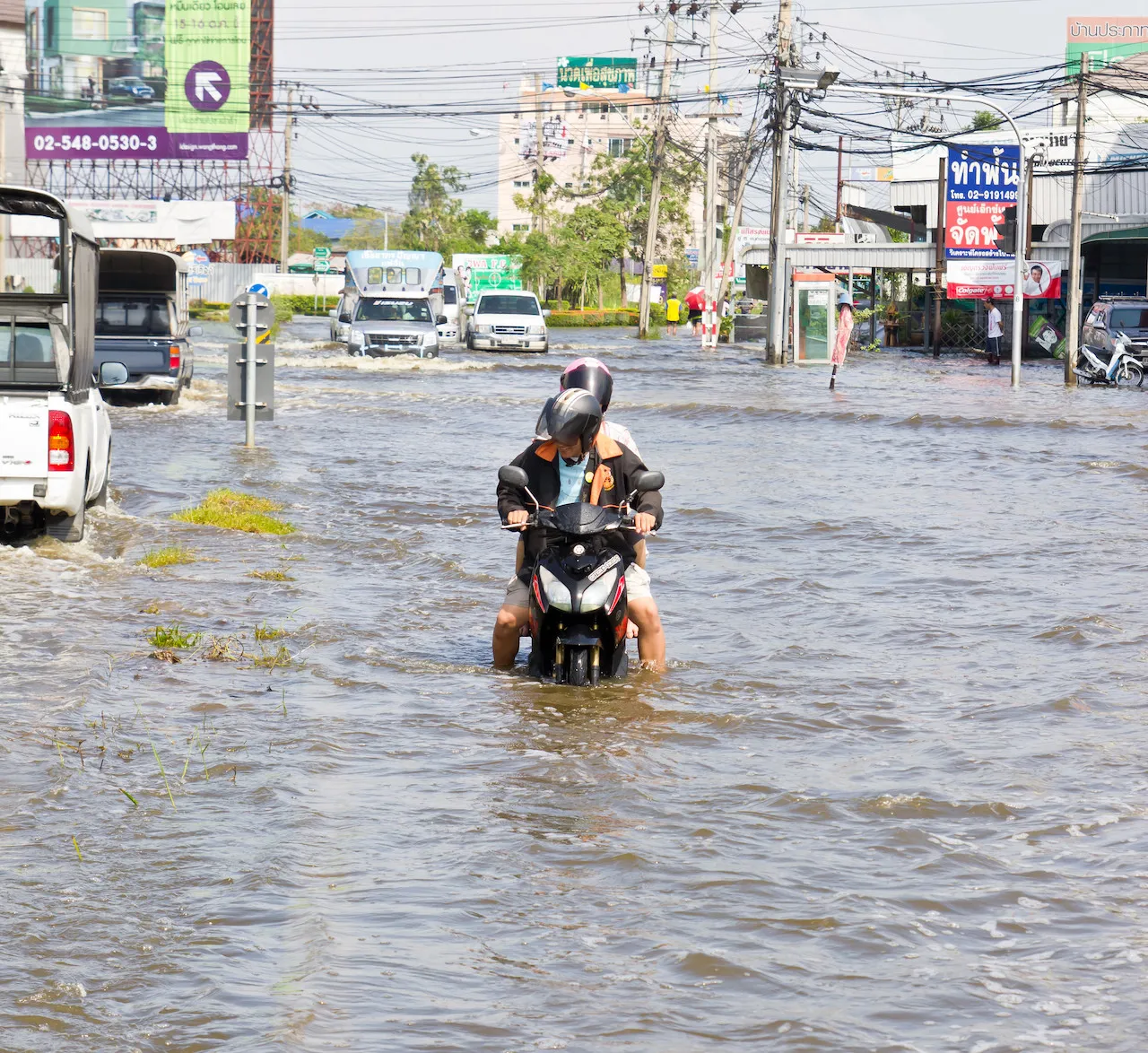
Flood Losses Hit 12.3 Billion Baht as Bangkok Bears the Brunt
BANGKOK, Thailand – Flooding across Thailand has inflicted an estimated 12.283 billion baht in economic damage, with Bangkok accounting for the largest share at about 7.014 billion baht, followed by the eastern region at 2.976 billion baht, according to the University of the Thai Chamber of Commerce’s Centre for Economic and Business Forecasting.
Soldiers Deployed to Clear Suvarnabhumi Baggage Backlog After Flood Chaos
UTCC president Dr Thanavath Phonvichai said the figure covers five days of flooding from 25 to 29 September across Bangkok and 26 provinces in the central, eastern, northern and northeastern regions, equivalent to 0.066 per cent of this year’s GDP projection. The estimate ranges from 5.896 to 20.635 billion baht, or 0.03 to 0.11 per cent of GDP, depending on actual flooded areas and how far halted activity can be offset. The figures exclude property damage — homes, vehicles, stock and crops — which will be clearer within a week of the waters receding, and could be revised if flooding persists.
Bangkok’s 7.014 billion baht represents 57 per cent of the total, reflecting its role as the country’s biggest economic hub and centre of commerce and services dependent on commuter movement. Although flooding struck mostly the eastern side of the capital, the financial sector and many offices continued working remotely, softening the blow. The four surrounding provinces — Samut Prakan, Pathum Thani, Nonthaburi and Nakhon Pathom — saw combined damage of 1.839 billion baht, with Samut Prakan worst affected.
The eastern region’s 2.976 billion baht was dominated by Chon Buri at 2.101 billion baht, where the flooding began and Pattaya’s waters reached nearly a metre deep. The province’s tourism, retail and port logistics are highly sensitive to travel disruption, though the Eastern Economic Corridor escaped largely unscathed and no industrial estates halted operations. Damage in the central, north and northeastern regions remained limited.
Consumption, tourism and services took the heaviest hit, with reduced spending at department stores, shops, restaurants and petrol stations, disrupted commutes, and special holidays on 28 and 29 September cutting working days in Bangkok and three neighbouring provinces. Pattaya and other Chon Buri destinations saw cancellations and postponed trips, hitting hotel and restaurant revenue, while flooded main roads hampered deliveries to retailers in Bang Kapi, Min Buri and Rangsit. Manufacturing felt indirect pressure from transport and labour constraints, but factories avoided direct damage — a far cry from 2011.
Vegetable prices have risen, a trend to be watched until the Vegetarian Festival from 10 to 18 October, while inflation effects are expected to be limited and temporary. In agriculture, the main risk now lies in Chao Phraya basin provinces such as Chai Nat, Sing Buri, Suphan Buri and Ayutthaya, where water is still rising as crops near harvest, with losses to become apparent once the floods recede.
Jet Ski Rider Charged For Drifting Through Bangkok Floodwaters On Main Street
The centre puts the damage at about 0.26 per cent of third-quarter GDP, after growth slipped from 2.8 per cent in the first quarter to 1.9 per cent in the second, saying the initial estimate is not severe enough to alter this year’s economic trajectory but will add pressure in the second half, especially if Chao Phraya flooding spills into the fourth quarter. It recommends three responses: swift relief for affected groups, focusing on informal workers and small businesses in Bangkok and nearby provinces through debt moratoria and recovery loans; better Chao Phraya basin management to protect farmland and industrial estates in the southern Central region, with fast damage assessments to speed compensation; and close monitoring of essential goods prices until the Vegetarian Festival alongside investment to boost the Bangkok Metropolitan Administration’s drainage capacity against future floods.
-Thailand News (TN)